


Overview
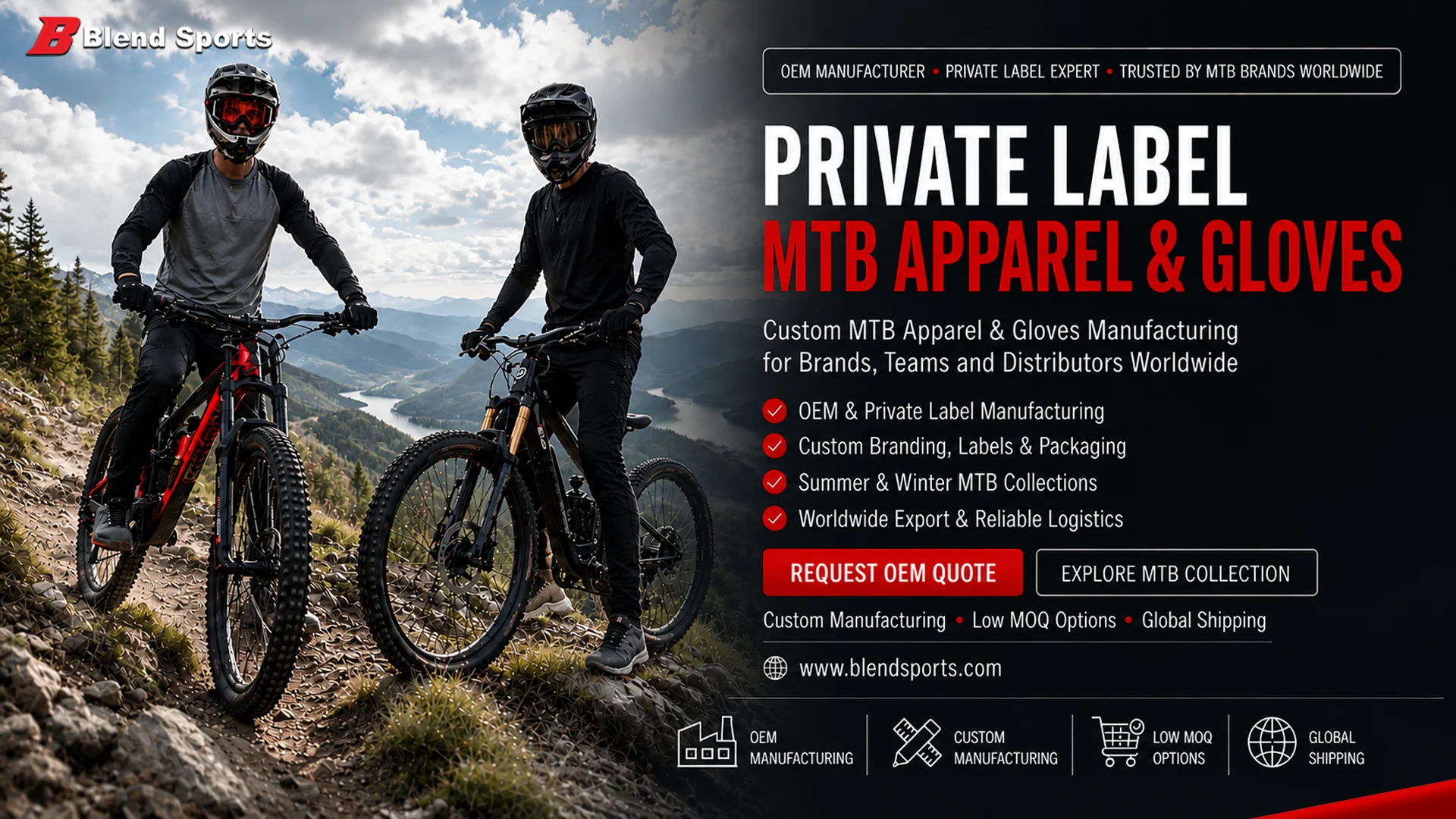
Mountain bike apparel and gloves face a unique combination of mechanical stress, environmental exposure, and ergonomic demands. From abrasion against trail debris and handlebar vibration to rapid weather changes during elevation shifts, standard cycling or outdoor gear does not withstand the specific conditions of trail, enduro, and downhill riding.
Blend Sports produces private-label MTB apparel and gloves built for these demands — articulated patterning for rider position, reinforced palm zones for handlebar and brake control, breathable fabrics with abrasion-resistant overlays, and weather-adaptive layering systems. Consistent production supports inventory planning and enables timely seasonal deliveries across spring, summer, and autumn riding programmes.
Scalable manufacturing meets the requirements of emerging mountain bike brands and established labels expanding their technical apparel lines, with specifications maintained from sampling through bulk production.
Why Riding Discipline Determines Every Specification Decision
Trail, enduro, and downhill disciplines create fundamentally different stress patterns on apparel and gloves. Understanding these distinctions before development begins prevents costly specification mismatches and product failures in the field.
| Riding Discipline | Primary Stress Type | Apparel Impact Zone | Glove Impact Zone | Specification Priority |
|---|---|---|---|---|
| Trail / XC | Sustained pedalling, body heat, light brush contact | Inner thigh, lower back (sweat/heat) | Palm centre (handlebar pressure) | Moisture management, lightweight breathability |
| Enduro / All-Mountain | Alternating climbs and descents, variable terrain | Knee, hip, outer thigh (abrasion/impact) | Finger joints, knuckles (branch contact) | Balanced ventilation with reinforced abrasion zones |
| Downhill / Freeride | High-speed descent, frequent falls, maximum abrasion | Knee, elbow, shoulder, hip (impact and slide) | Full hand (fall contact, grip fatigue) | Maximum abrasion resistance, impact protection integration |
| Gravity / Park | Repeated lift access, bike park features, jump landings | Seat contact, hip (repetitive impact) | Palm heel (landing compression) | Durability under repeated compression, quick-dry liner |
Specification decisions made without discipline-specific input result in products that underperform or fail prematurely. Segment-specific benchmarks ensure apparel and gloves match physiological and mechanical demands before production approval.
What We Manufacture: Product Categories
- MTB Gloves: Full-finger and half-finger designs with reinforced synthetic leather palms, silicone grip patterns, knuckle protection options, and touchscreen-compatible fingertips. Ventilated backs with 4-way stretch mesh for temperature regulation during climbs.
- MTB Jerseys: Short-sleeve and long-sleeve technical jerseys in moisture-wicking polyester or polyester-spandex blends. Relaxed fit for body armour compatibility, with drop-tail hem for lower back coverage during aggressive riding positions.
- MTB Shorts: Baggy outer shorts with detachable liner options, reinforced seat panels, and zippered venting. DWR-treated fabrics shed light precipitation and mud splatter.
- MTB Pants: Slim-fit technical pants for downhill and enduro with articulated knee patterning for pad compatibility, reinforced inner ankles for drivetrain protection, and stretch panels for pedalling mobility.
- Protective Layers: Lightweight impact vests, knee and elbow pad sleeves, and back protection compatibility built into jersey and vest designs.
- Cold Weather Kits: Thermal long-sleeve jerseys, wind-blocking jackets, and insulated glove variants with Hipora® membrane compatibility for wet-weather riding.
The private label program offers branded production and technical support, allowing brands to expand their MTB lines through Blend Sports' manufacturing expertise and material sourcing capabilities.
How MTB Conditions Dictate Technical Requirements
Mountain bike apparel must perform across a wider environmental range than road cycling gear, often within a single ride. Elevation changes, forest canopy transitions, and weather variability create conditions that require adaptive material systems.
| Environmental Factor | Road Cycling Baseline | MTB Demand | Manufacturing Solution |
|---|---|---|---|
| Surface abrasion | Minimal (smooth pavement) | High (rock, root, soil contact during falls) | Cordura® or ballistic nylon overlays at knee, hip, and outer thigh; reinforced palm leather with silicone grip |
| Moisture exposure | Predictable (sweat, occasional rain) | Variable (stream crossings, mud, sudden rain, heavy perspiration) | Quick-dry polyester base with DWR treatment; moisture-wicking lining in gloves |
| Temperature swing | Gradual change over long rides | Rapid (elevation gain/loss, canopy transitions) | Layer-compatible fits; venting systems; thermal mapping in cold-weather variants |
| Impact risk | Low (controlled traffic environment) | High (falls, trail obstacles, jump landings) | Impact pad compatibility in pattern design; reinforced stitching at stress points |
| Handlebar vibration | Moderate (smooth road, engineered bar tape) | Severe (rough trail, rigid fork feedback, prolonged braking) | Vibration-dampening palm padding; articulated finger patterning to reduce fatigue |
Addressing these condition-driven requirements during specification development prevents the failure modes common in apparel manufactured for general cycling use rather than mountain bike-specific demands.
Apparel Development & Process Control
Developing MTB apparel and gloves requires precise pattern grading, panel alignment for rider position, and reinforced stitching in high-wear areas to ensure fit, comfort, and durability across varied terrain.
Pattern Development & Fit Control: Multi-panel shapes are optimised for the forward-leaning riding posture, with extended rear hems, articulated knees, and pre-curved sleeves that reduce fabric bunching during handlebar reach.
Material Selection: Technical fabrics are selected for breathability, abrasion resistance, and stretch recovery — including polyester-spandex blends, Cordura® overlays, and mesh ventilation panels mapped to high-heat body zones.
Seam Integrity & Stitching: Bonded nylon 6,6 thread and controlled stitch density reinforce stress zones (crotch, inner thigh, knee articulation) while flatlock seams reduce chafing during prolonged contact with saddle and pads.
Quality Control: Material checks, in-line inspections, and final pre-shipment audits ensure consistency across production batches.
AQL 2.5 Inspection Protocol: A four-step quality control process including material checks on arrival, in-process inspections, pre-shipment reviews, and a final AQL 2.5 audit.
Production Scaling: Volumes are planned from pilot runs to seasonal bulk orders to ensure consistency across all units.
Articulated Pattern Design
Standard athletic patterns do not accommodate the dynamic body positions of mountain biking. The forward lean, knee bend, and shoulder reach create stress points that flat patterns cannot resolve.
- Rider-Position Sleeve Angle: Sleeves are pre-shaped for handlebar reach, eliminating shoulder tension and sleeve ride-up during descent positions.
- Knee Articulation: Pre-bent knee panels with gusseted crotch panel allow full pedal rotation without fabric restriction or seam stress.
- Drop-Tail Hem: Extended rear hem provides lower back coverage during aggressive riding angles, preventing exposure when leaning forward.
- Body Armour Compatibility: Relaxed fit through torso and arms accommodates back protectors and elbow pads without compression or mobility loss.
Why Articulation Matters: Flat-cut apparel creates pressure points and seam fatigue during sustained riding positions. Pre-shaped patterning supports natural mechanics from first wear through repeated laundering cycles.
Glove Pattern Specifics
Pre-Curved Finger Box: Fingers are patterned in a natural grip position, reducing material bunching and improving brake-lever control feedback.
Strategic Seam Placement: Seams are offset from high-pressure contact zones (palm centre, thumb webbing) to prevent pressure points during sustained braking and handlebar grip.
4-Way Stretch Knuckle Panels: Lycra® or mechanical stretch woven fabric at knuckles preserves range of motion during finger flexion for brake and shift operation.
Manufacturing Specifications by Riding Style
| Discipline | Apparel Specification | Glove Specification | Performance Priority |
|---|---|---|---|
| Trail / XC | Lightweight jersey (130–160gsm), breathable mesh panels, minimal seams | Lightweight full-finger; minimal palm padding; breathable mesh back | Heat dissipation and pedalling efficiency |
| Enduro / All-Mountain | Mid-weight jersey with abrasion overlays, convertible venting, relaxed fit for pads | Medium padding; reinforced knuckles; touchscreen fingertips | Versatile durability across variable terrain |
| Downhill / Gravity | Heavy-duty fabric (180–220gsm), reinforced seat and knees, integrated impact zones | Maximum palm padding; hard-shell knuckle protection; extended wrist coverage | Impact protection and abrasion resistance |
| Jump / Park | Durable stretch fabric, pre-shaped knee for pad integration, hip reinforcement | Reinforced heel padding; wrist stabilization; quick-dry liner | Compression recovery and repeated impact durability |
Activity intensity and terrain type influence specification requirements as much as ambient temperature. Segment-specific benchmarks ensure apparel and gloves match physiological and mechanical demands before production approval.
Material & Fabric Choices
| Component | Standard | Upgrade | Performance Difference | Application |
|---|---|---|---|---|
| Jersey Body | Basic polyester (130–160gsm) | Moisture-wicking polyester-spandex blend with antimicrobial treatment | Improved sweat transport, odor control, shape retention | High-output trail and enduro riding |
| Abrasion Overlays | Basic nylon reinforcement | Cordura® or ballistic nylon 6,6 | 3–5x abrasion resistance improvement; longer service life in fall zones | Downhill, enduro, gravity riding |
| Shorts Outer | Lightweight polyester with DWR | Stretch-woven nylon with DWR and reinforced seat | Greater mobility, improved water resistance, extended seat durability | All-mountain, bike park, wet conditions |
| Glove Palm | PU synthetic leather (0.8–1.0mm) | Reinforced synthetic with silicone grip pattern | Improved wet grip, vibration dampening, extended wear life | All disciplines; essential for enduro and downhill |
| Glove Back | Basic mesh | 4-way stretch breathable mesh with knuckle relief panel | Enhanced mobility, temperature regulation, reduced pressure on knuckle joints | High-output riding, warm climates |
| Cold-Weather Membrane | Wind-blocking fleece | Hipora® breathable membrane with thermal mapping | Wet-weather protection with vapor transmission; targeted insulation zones | Winter MTB, high-elevation riding |
Material selection directly influences the durability, comfort, and protective performance of MTB apparel and gloves. Upgrades are matched to brand positioning and intended riding discipline.
Custom MTB-Specific Design Details
Jersey and Top Stitching
Drop-Tail Hem: Extended rear hem (2–3 inches longer than front) maintains lower back coverage during forward-leaning riding positions.
Helmet-Compatible Hood: Optional hood designs integrate with helmet shape without bunching, using stretch paneling for secure fit during head movement.
Zippered Venting: Underarm and side-panel zippers allow on-the-fly temperature regulation during climb-to-descent transitions.
Goggle Wipe Integration: Microfiber panel at inner hem for lens cleaning without carrying a separate cloth.
Shorts and Pants Stitching
Adjustable Waist Systems: Hook-and-loop side tabs or internal elastic adjustment accommodate body armour layers and personal fit preference.
Phone/Tool Pocket Positioning: Zippered thigh pockets positioned for seated access, with secure closure to prevent loss during jumps and drops.
Drivetrain Protection: Reinforced inner ankle panels (on pants) resist chainring contact and oil staining.
Pad Integration: Pre-shaped knee and hip zones accommodate removable impact pads without shifting or compression.
Glove Design Features
Silicone Grip Pattern: Strategic silicone print on palm and fingers maintains lever control in wet and muddy conditions.
Touchscreen Compatibility: Conductive treatment on thumb and index fingertip allows GPS and phone operation without removing gloves.
Knuckle Protection Options: Flexible TPU or EVA padding integrated into backhand panel for branch and rock contact protection.
Wrist Closure Variants: Hook-and-loop cuff for quick adjustment, or extended gauntlet style for debris and weather protection.
Cold Weather MTB Technical Specifications
Cold-weather mountain biking creates unique thermal management challenges. Riders generate substantial heat during climbs but cool rapidly during descents, often in wet or windy conditions.
Trail / XC Cold Weather
- Lightweight thermal jersey with brushed interior
- Wind-blocking front panel only
- Full-finger glove with light insulation (60g–80g)
- Operating range: 35°F to 50°F active
Enduro Cold Weather
- Mid-weight thermal jersey with DWR treatment
- Convertible venting for climb heat release
- Insulated glove with Hipora® membrane
- Operating range: 25°F to 45°F variable
Downhill Cold Weather
- Heavy thermal layer with abrasion shell
- Windproof membrane across all panels
- Maximum insulation glove with wrist gauntlet
- Operating range: 15°F to 35°F static/descent
Cold-weather specifications must account for the stop-start thermal pattern of mountain biking, where fixed insulation often leads to overheating on climbs. Layer-compatible designs and variable-venting systems outperform single-layer approaches.
Reinforced Stitching & Longevity Details
High-Stress Reinforcement Zones
- Crotch and Inner Thigh: Double-needle stitching with bonded nylon 6,6 thread prevents seam failure from saddle friction and pedalling motion.
- Knee Articulation: Bar-tacked stress points and gusseted panel layout distribute flex stress across multiple panels.
- Seat Panel: Reinforced saddle-contact zone with abrasion-resistant overlay extends short and pant lifespan.
- Glove Palm and Thumb Web: Double-stitched palm overlay and reinforced thumb base prevent blowout from handlebar grip and brake-lever pressure.
- Cuff and Closure: Bar-tacked strap attachments withstand repeated pulling and adjustment forces.
Reinforced stitching with high-bonded thread distributes stress across panels, extending product life through repeated flex cycles, abrasive contact, and laundering.
Seam Placement for Comfort
Offset seams on jerseys and tops prevent pressure points when wearing hydration packs. Flatlock seams on glove fingers reduce irritation during extended rides. Strategic panel alignment on shorts ensures freedom of movement for full suspension compression and extension.
Features That Support On-Trail Functionality
Moisture and Temperature Management
Mountain biking generates significant perspiration even in cool conditions. Proper apparel architecture addresses this through:
- Ventilation Mapping: Mesh panels at high-heat zones (underarm, lower back, inner thigh) remain closed during precipitation through zippered or flap-covered design.
- Quick-Dry Zones: Hydrophilic fibre treatments in glove liners and jersey panels accelerate evaporation during descent rest periods.
- Layer Compatibility: Relaxed fit through torso and arms accommodates base layers without compression, enabling thermal adjustment across elevation changes.
Pack and Armour Integration
Modern mountain bikers ride with hydration packs, back protectors, and limb pads. Apparel must accommodate these without shifting or creating pressure points:
- Shoulder Seam Offset: Relocated to avoid pack strap pressure and friction during technical descents.
- Pad Pockets: Integrated sleeve pockets for elbow pads prevent migration during arm movement.
- Waistband Compatibility: Low-profile waist and adjustable closure systems work with hip packs and back protector straps.
Safety and Visibility Features
- Reflective Details: 3M Scotchlite™ or equivalent on cuffs, hems, and logos for low-light trailhead and road-crossing visibility.
- CE-Level Impact Compatibility: Garment patterning accommodates CE-certified back, knee, and elbow protectors.
- Emergency ID Pocket: Concealed interior pocket for medical and emergency contact information.
Video summary: Downhill riders tackle high-speed descents, technical stunts, and challenging trails, illustrating the performance demands placed on MTB jerseys, gloves, hoodies, jackets, pants, and other custom gear manufactured for private-label brands.
MTB Manufacturing Approach
The private label program supports mountain bike brands developing custom MTB apparel and gloves with technical fabrics, articulated patterning, and reinforced stitching for trail, enduro, and downhill disciplines.
Since 2015, material selection and performance validation have been qualified specifically for mountain bike conditions, including abrasion resistance, moisture management, and handlebar-specific glove wear patterns. Sampling validates performance under MTB-specific stress before production approval.
Production management covers the complete cycle — from pattern development to multi-stage quality checks — while maintaining approved materials, measurements, tolerances, and branding requirements.
MTB Apparel Design Trends
Sustainable Material Alternatives
Recycled polyester (rPET) and bluesign®-approved fabrics are increasingly specified for environmentally positioned MTB brands. Performance parity with conventional materials achieved for most trail and enduro applications.
Convertible Layer Systems
Removable liner shorts, zip-off sleeves, and modular glove systems allow riders to adapt to changing conditions without carrying multiple garments. This reduces pack weight and improves ride flexibility.
Integrated Impact Protection
Apparel with built-in low-profile impact foam at hips, knees, and shoulders reduces the need for separate pads in trail and light enduro riding. Integration requires precise patterning to maintain comfort and mobility.
Advanced Palm Grip Systems
Silicone polymer grip patterns and vibration-dampening gel inserts are now standard specifications for enduro and downhill gloves, improving lever control and reducing hand fatigue on technical descents.
Production Capabilities and Quality Assurance
Since 2015, material selection has been qualified specifically for mountain bike conditions, including wet-weather abrasion resistance, repeated flex cycling at knee and elbow articulation, and impact absorption at fall zones. Sampling validates performance under MTB-specific stress patterns before production approval.
Production follows approved technical documentation, including the tech pack, specified materials, measurements, and tolerances. No material substitution or design change is made without prior authorization.
Quality Control Protocol
Material Verification: Incoming fabric inspection for weight, stretch recovery, abrasion rating, and colour consistency
In-Process Inspection: Stitch density verification at high-stress zones; panel alignment accuracy for articulated patterning
Pre-Shipment Review: Abrasion overlay adhesion testing; seam strength validation; glove grip pattern integrity
Final AQL 2.5 Audit: Random sampling ensures batch consistency meets specification tolerance
ISO 9001:2015 Certified: Blend Sports adheres to ISO 9001:2015 for consistent quality from sampling through production
Development Process & Timelines
- Weeks 1-2: Product Definition
Review riding discipline (trail vs. enduro vs. downhill), biomechanical requirements, and material feasibility assessment. - Weeks 3-6: Prototype Development
Two prototype rounds with field validation testing fit, articulation, and abrasion resistance under actual riding conditions. - After Sample Approval: Pre-Production Confirmation
Final sample approval, size grading confirmation, and production planning before bulk manufacturing begins. - Bulk Production & Quality Control
Bulk production typically takes 60–90 days and includes multi-stage inspection from incoming materials through final AQL 2.5 sampling.
Typical Timeline: Sampling takes 4–6 weeks after specifications and materials are confirmed. Bulk production takes 60–90 days after sample approval and order confirmation.
Cost Structure
Volume Pricing Mechanism
| Annual Volume | Cost Reduction | Cost Driver |
|---|---|---|
| 1,000+ units | 5–8% | Dedicated line allocation, reduced setup overhead |
| 2,000+ units | 10–14% | Material pre-positioning, custom dye lot efficiency |
| 3,500+ units | 15–18% | Fabric volume licensing, component moulding investment |
Performance Enhancement Costs
| Feature | Cost Impact | Performance Benefit |
|---|---|---|
| Cordura® abrasion overlay | + $1.50 / unit | 3-5x abrasion resistance at knee, hip, and seat zones |
| Silicone grip palm pattern | + $0.80 / pair | Improved wet handlebar and brake-lever control |
| Hipora® membrane (cold-weather glove) | + $1.50 / pair | Windproof barrier with moisture release for winter riding |
| DWR treatment (apparel) | + $0.75 / unit | Light precipitation and mud-splash resistance |
| Antimicrobial fabric treatment | + $0.75 / unit | Odor control, extended wear between washing |
| Integrated impact pad pocket | + $1.00 / unit | CE-level protector compatibility without garment shifting |
Volume Considerations:
- 300–500 units: Baseline pricing (typical MOQ)
- 1,000 units: 8% reduction
- 2,500+ units: 12% reduction
Development Costs:
- Pattern development: $100–200 (one-time)
- Additional prototype rounds: $200–350 each
MTB Apparel & Glove Development Checklist for Brands
Technical specification framework for private label MTB apparel and glove development:
Apparel
- Riding discipline specified: trail, enduro, downhill, or multi-discipline
- Fabric weight and stretch requirement matched to intended use
- Abrasion overlay placement at knee, hip, seat, and outer thigh
- Body armour compatibility confirmed in pattern grading
- Ventilation mapping for climb heat release
- DWR treatment specification for wet-weather variants
Gloves
- Palm material: synthetic leather grade and silicone grip specification
- Finger length: full-finger or half-finger per discipline
- Knuckle protection: TPU, EVA, or none per risk assessment
- Touchscreen compatibility for GPS and phone operation
- Wrist closure style: hook-and-loop cuff or extended gauntlet
- Cold-weather membrane specification if applicable
Design Details
- Drop-tail hem length for lower back coverage
- Pocket placement for seated access with secure closure
- Reflective element placement for low-light visibility
- Graphics application: sublimation, screen print, or embroidered
Quality & Compliance
- Stitch density specification at high-stress zones
- Abrasion test rating for overlay fabrics (Martindale or equivalent)
- Four-stage quality control: incoming material, in-process, pre-shipment, final AQL 2.5 audit
- ISO 9001:2015 certification confirmation
Technical Inquiry
Submit your product requirements for review. Our production team will assess feasibility, recommend specifications, and outline sampling and production protocols.
Frequently Asked Questions: MTB Manufacturing
What are your minimum order quantities for custom MTB apparel and gloves?
Minimum order quantities depend on design complexity. We support both emerging brands launching their first private-label products and established brands scaling proven designs.
How do you address palm wear from handlebar grip and brake levers?
Reinforced synthetic leather palms with silicone grip overlays are designed for sustained handlebar contact. Strategic reinforcement at thumb and index finger bases extends service life compared with standard finishing.
What fabric setup is best for trail versus downhill riding?
Trail riders benefit from breathable, lightweight fabrics with moisture-wicking for climbs. Downhill riders require abrasion-resistant outer layers with impact padding and reinforced knee and elbow zones.
How long does MTB apparel development take from sample to delivery?
Sampling typically takes 4 to 6 weeks after specifications and materials are confirmed. Bulk production typically takes 60 to 90 days after sample approval and order confirmation.
Do you support OEM and private label MTB apparel projects?
Yes. OEM and private label programs are supported with pattern development, material selection, branded execution, sampling, and production planning.
Do you provide samples before production?
Yes. Pre-production samples are provided to ensure that fit, materials, trims, and hardware meet tech-pack specifications before the full production run begins.
What markets do you serve as an MTB apparel manufacturer?
Blend Sports works with brands across North America and Europe, supporting both emerging and established mountain bike and cycling brands.
How do you ensure consistent quality in custom MTB apparel manufacturing?
Production follows approved technical documentation with no material substitutions or design changes without prior authorization. Quality checks cover incoming materials, in-process workmanship, pre-shipment review, and a final AQL 2.5 audit within Blend Sports' ISO 9001:2015 quality management framework.