


Overview
Private label fitness gear manufacturing for commercial gym chains, boutique studios, and fitness brands requires a different standard than consumer retail products.
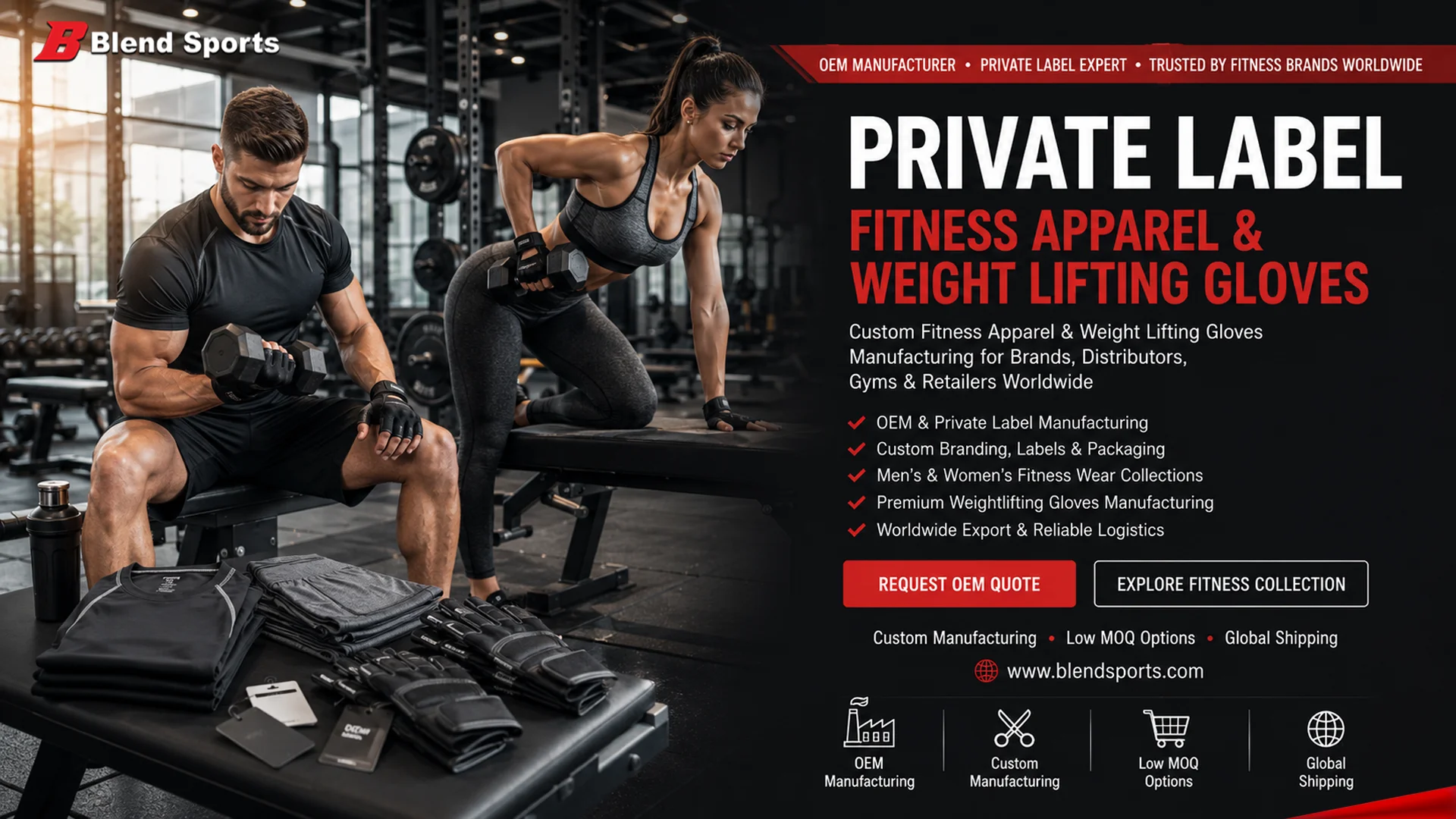
Commercial gym environments cycle through equipment faster than individual consumers. Barbells, benches, and flooring absorb constant use, but the gloves and apparel worn by members face a different stress profile — repeated laundering, abrasive contact with textured barbells, and sustained sweat exposure that degrades standard builds within weeks. Private-label fitness gear produced by Blend Sports is designed for these conditions, supporting procurement teams at commercial gym chains, boutique studios, and fitness brands. Production capabilities are aligned with procurement requirements: consistent batch quality for predictable replacement scheduling, scalable volumes from pilot programmes to seasonal retail, and quality controls that reduce supplier variability and protect inventory planning.
What We Manufacture: Product Categories
- Weightlifting Gloves: Fingerless and full-finger designs, padded palm configurations, wrist wrap integration, synthetic or genuine leather.
- Cross-Training Gloves: Minimal padding for bar feel, breathable mesh backs, grip-enhancing palm treatments, quick-dry linings.
- Gym Apparel: Private label performance t-shirts, tank tops, shorts, and leggings designed for commercial laundering cycles and high-frequency training environments.
- Training Accessories: Lifting straps, wrist wraps, knee sleeves, resistance bands, and gym towels.
- Gym Bags: Duffels and backpacks with ventilated compartments, reinforced stitching, and branded hardware.
- Protective Gear: Lifting belts, elbow sleeves, and foam rollers for injury prevention and recovery.
How Commercial Gym Environments Dictate Technical Requirements
| Environmental Factor | Consumer/Home Use Baseline | Commercial Gym Demand | Blend Sports Solution |
|---|---|---|---|
| Wash frequency | Weekly or bi-weekly | Daily or multiple times per week | Reinforced stitching and colorfast fabrics that resist laundering damage |
| Contact surfaces | Smooth, controlled equipment | Knurled barbells, textured flooring, abrasive benches | Reinforced palm panels and abrasion-resistant outer layers |
| Sweat exposure | Individual use, moderate perspiration | Shared equipment, high-volume perspiration, salt corrosion | Antimicrobial treatments and quick-dry fabric treatments |
| Usage intensity | Moderate, variable schedules | High-frequency, back-to-back sessions | Durable build with reinforced stitching at stress points |
| Brand visibility | Personal preference | Logo durability for member retention and brand recognition | Sublimated or high-density screen-printed graphics that survive laundering |
Commercial gym equipment faces wear patterns that consumer-grade products cannot withstand. Understanding these environmental stressors early in development helps brands avoid replacement costs and member dissatisfaction.
Glove & Apparel Development & Process Control
Fitness glove and apparel development requires consistent pattern grading, fabric control, and trim selection. A standardised quality framework maintains batch-to-batch uniformity from sampling through bulk production.
To maintain consistency across high-volume production programs, each stage of development and manufacturing is standardised to reduce variation and ensure repeatable outcomes.
Pattern Development & Fit Control - Multi-panel shapes developed for grip security and natural hand movement during varied lifting and training movements.
Fabric Selection - Moisture-wicking polyester, 4-way stretch blends, abrasion-resistant palm materials, and antimicrobial treatments are selected for high-frequency gym use.
Reinforced Stitching - Reinforced double-needle stitching at high-stress points maintains integrity through repeated laundering and abrasive contact.
Quality Control - Incoming material checks, in-line inspections, and final pre-shipment audits are used to maintain batch consistency.
AQL 2.5 Inspection Protocol - A four-stage inspection process following AQL 2.5 standards ensures batch consistency and long-term performance.
Production Planning - Volumes are planned from pilot runs to seasonal bulk orders while maintaining consistency across units.
Ergonomic Pattern Development
Weightlifting and cross-training require hand and body positions that standard patterns do not account for: secure grip on textured bars, wrist stability under load, and freedom of movement for dynamic exercises.
- Pre-Curved Finger Patterns: Gloves shaped to natural grip position reduce hand fatigue and improve bar contact.
- Strategic Padding Placement: Palm-padding concentrated at high-pressure callus zones while maintaining bar-feel at the fingers.
- Wrist Support Integration: Optional rigid or elastic wrist wraps built into the glove for overhead lifts.
- 4-Way Stretch Panels: Mesh or spandex inserts at joints and back of hand for temperature regulation and mobility.
Production Impact: Flat-cut patterns can create pressure points during sustained grip work. Pre-shaped design supports natural mechanics from first wear through repeated laundering cycles.
Glove Specifications by Training Discipline
Training disciplines influence specification requirements during product development and bulk production planning.
Bodybuilding/General Fitness: Moderate palm padding for bar and machine work. Wrist wrap optional. Synthetic leather or high-grade microfiber. Velcro closure. Use: hypertrophy training, machine circuits, general gym use.
Powerlifting: Minimal palm padding for maximum bar feel. Integrated wrist support mandatory. Genuine or synthetic leather. Extended wrist wrap (2-3 inches). Use: squat, bench press, deadlift, heavy compound movements.
Cross-Training/HIIT: Minimal padding for bar feel and tactile feedback. Breathable mesh design. Quick-dry lining. Fingerless or minimal coverage. Use: Olympic lifts, kettlebell work, bodyweight exercises, high-intensity intervals.
Commercial Gym Provisioning: Durable synthetic build for shared use. Standardized sizing. Reinforced stitching at stress points. Cost-optimized for volume replacement cycles. Use: member loaner programs, rental equipment, new member onboarding.
Material & Fabric Choices
| Part | Standard | Upgrade | What You Get | Best For |
|---|---|---|---|---|
| Glove Palm | PU synthetic leather (0.6-0.8mm) with basic padding | Genuine leather (0.8-1.0mm) or advanced synthetic with gel/foam layering | Improved bar feel, durability through repeated laundering, grip security | Heavy lifting, commercial gym provisioning, frequent use |
| Glove Back | Basic polyester mesh | 4-way stretch mesh with moisture-wicking treatment | Enhanced breathability, shape retention, quick-dry performance | High-intensity training, hot environments, back-to-back sessions |
| Wrist Support | Basic elastic strap | Rigid insert or extended elastic wrap (2-3 inches) | Stabilization under load, injury prevention, overhead lift security | Powerlifting, heavy compound movements, wrist injury history |
| Apparel Fabric | Basic polyester (130-160gsm) | Moisture-wicking polyester-spandex blend (180-220gsm) with antimicrobial treatment | Odor control, shape retention, durability through repeated washing | Commercial gym environments, daily use, member retention programs |
| Apparel Specifications | Standard stitching | Flatlock seams and reinforced stress points | Reduced chafing, extended garment life, professional appearance | High-frequency use, commercial laundering, premium positioning |
| Graphics Application | Basic screen printing | Sublimation or high-density screen printing | Improved crack and fade resistance through repeated washing | Brand visibility, member retention, long-term apparel programs |
| Lifting Straps | Cotton webbing | Heavy-duty nylon or leather with reinforced stitching | Secure grip under maximal loads, extended product life | Deadlift, rowing, heavy pulling movements |
| Resistance Bands | Latex rubber | Layered latex with fabric covering or snap-resistant polymer | Snap prevention, consistent resistance profile, extended use | Commercial gym provisioning, physical therapy, high-frequency use |
| Lifting Belt | Heavy-duty nylon webbing (4" width, single-prong buckle) | Full-grain leather (10mm competition or 13mm powerlifting), lever or double-prong buckle | Increased core support under maximal loads; leather maintains rigidity through repeated use where nylon softens over time | Nylon: commercial gym provisioning, volume programs, price-sensitive positioning. Leather: powerlifting, competition programs, premium positioning |
| Elbow Sleeves | Basic neoprene sleeve (3mm) | Compression-grade neoprene (5–7mm) with reinforced seams and anti-slip lining | Improved joint warmth and stability under load; anti-slip lining prevents sleeve migration during heavy pressing | Powerlifting, heavy pressing movements, injury prevention and recovery |
Technical Note: Premium synthetic leathers and high-performance stretch materials are used alongside high-quality unbranded equivalents, matched to each brand's performance requirements, durability thresholds, and price points.
Custom Fitness Gear Design Details
Material Selection by Market Segment
Material weight, reinforced stitching at stress points, and treatment determine performance, fit and performance validation.
Commercial Gym Provisioning: Durable synthetic make (PU leather, high-denier nylon) optimised for cost and replacement cycles. Reinforced stitching at stress points. Standardized sizing for broad member fit. Sublimated or screen-printed graphics for brand visibility.
Boutique Studio Positioning: Premium materials (genuine leather options, advanced synthetics) with distinctive design elements. Antimicrobial treatments for close-contact environments. Coordinated apparel and accessory collections. Sublimated graphics for premium brand presentation.
Direct-to-Consumer Fitness: Balanced material specification meeting price-performance ratios. Quick-dry and antimicrobial treatments as standard. Social media-ready aesthetic with distinctive colorways. Packaging and unboxing experience considerations.
Shell Design Options
Commercial Gym Provisioning Specs
Cost-optimized synthetic production. Reinforced stitching at palm and wrist stress points. Standardized sizing (S/M/L/XL). Basic velcro closure. Sublimated or screen-printed graphics. Packaged for bulk distribution and member loaner programs.
Boutique Studio Premium Specs
Top-grain leather or advanced synthetic leather options. Gel or layered foam padding. Extended wrist support (2-3 inches). 4-way stretch mesh design. Antimicrobial treatments. Coordinated apparel collection. Sublimated graphics. Premium packaging.
Powerlifting-Specific Specs
Minimal palm padding for maximum bar feel. Integrated rigid wrist support. Genuine leather designs. Extended wrist wrap (3+ inches). Reinforced thumb and finger design. Competition-legal specifications where applicable.
Glove specification should align with intended use: commercial provisioning prioritizes durability and cost; boutique positioning prioritizes member experience and brand differentiation; powerlifting prioritizes performance and injury prevention.
Workmanship & Longevity Details
Reinforced Stitching at High-Stress Zones
- Palm and finger seams (repeated bar contact and abrasive wear)
- Wrist closure and strap attachments (pulling and twisting forces)
- Thumb saddle (grip stress and material fatigue)
- Apparel seams at rise, underarms, and waistband (movement and laundering stress)
Reinforced double-needle stitching at these zones distributes stress across panels, extending product life through repeated laundering cycles and high-frequency gym use.
Seam Placement for Comfort
Flatlock seams on apparel prevent chafing during dynamic movements. Offset seam placement on gloves avoids pressure points against barbells and dumbbells. Strategic panel alignment ensures freedom of movement for full range of motion exercises.
Features That Support Training Environments
Sublimated Graphics
Dye-sublimation printing bonds ink to polyester fibers during heat transfer, creating integrated graphics that resist cracking and abrasion. Commonly specified for apparel and accessories due to durability requirements during repeated laundering and gym use.
Antimicrobial Treatments
Silver-ion or equivalent treatments specified for gear used in shared gym environments. Reduces odor and bacterial growth in gloves, apparel, and accessories during daily use and repeated laundering.
Quick-Dry Treatments
Hydrophobic fiber treatments and mesh design accelerate moisture evaporation. Reduces downtime between sessions for commercial gym provisioning. Improves comfort during high-intensity training.
Adjustable Closure Systems
Velcro closures for self-application and quick adjustment. Extended wrist wraps for powerlifting stability. Elastic integrations for secure fit across varied hand sizes. Standardized for commercial gym loaner programs.
Fitness Gear Manufacturing Approach
The private label program supports fitness brands developing custom fitness gloves, gym apparel, and training accessories with material specifications, ergonomic patterning, and reinforced making for commercial gyms, boutique studios, and direct-to-consumer markets.
Since 2015, fabrics, padding configurations, and build methods have been tested specifically for high-frequency gym use — not general consumer wear. Testing has identified which synthetic leathers resist laundering damage, which mesh patterning maintains shape through repeated washing, and which seam work survives abrasive bar contact.
This material testing provides the basis for technical guidance on specifications across different training environments and market segments.
Production management covers the complete cycle — from pattern development to multi-stage quality checks — ensuring consistency across production runs. A first-round manufacturing yield of 96% supports on-time delivery for seasonal delivery cycles and commercial provisioning schedules in North America and Europe.
Fitness Gear Design Resources
Developing reliable fitness equipment requires careful material selection, ergonomic pattern development, and reinforced build methods that support high-frequency gym use. These guides explain the specifications used across commercial gym, boutique studio, and direct-to-consumer segments.
Fitness Gear Design Trends
Sustainable Material Alternatives
Recycled polyester (rPET) and plant-based synthetic leathers increasingly specified for environmentally positioned brands. Performance parity with conventional materials achieved for most gym applications.
Coordinated Collection Development
Boutique studios and direct-to-consumer (DTC) brands now specify complete accessory and apparel collections with unified aesthetic and material language. Coordinated launches improve brand recognition and member retention.
Retail-Ready Packaging:
Unboxing experience and sustainable packaging now standard considerations for direct-to-consumer fitness brands. Packaging specs are integrated with product development for a seamless direct-to-consumer experience.
Technical Fitness Apparel vs General Sports Apparel
Fitness apparel and general sports apparel may share base materials, but stitching standards and durability requirements differ significantly in high-frequency gym environments.
Technical fitness apparel must withstand repeated laundering, abrasive contact with equipment, and sustained sweat exposure that standard apparel is not designed to handle.
- Laundering Durability: Reinforced stitching at stress points and colorfast fabrics maintain integrity through frequent wash cycles; general apparel degrades under similar conditions.
- Abrasion Resistance: Knurled barbells and textured surfaces create wear patterns that standard materials cannot withstand; fitness-specific products use reinforced panels and durable stitching in high-contact areas.
- Odor Management: Antimicrobial treatments and quick-dry fabrics manage sweat exposure in shared environments; general apparel lacks these specifications.
- Ergonomic Design: Pre-curved patterns and targeted reinforcement support grip stability and movement under load; standard patterns create pressure points during repeated use.
While materials may overlap, stitching standards, durability requirements, and performance specifications are defined by high-frequency gym use.
Development Process & Timelines
Product Definition (Weeks 1-2)
Brand partners provide tech packs or concept direction. Technical guidance is provided on material specifications, ergonomic patterning, and stitching methods suited to the intended training use and product positioning.
Sampling (Weeks 3-6)
Two prototype rounds utilizing production-grade fabrics and trim. Field testing in target gym environments is recommended to validate fit and sizing, durability, and performance before mass production.
Pre-Production Alignment (Weeks 7–8)
Final sample approval, size grading confirmation, and production planning before bulk manufacturing begins.
Production (Weeks 9-14)
Four-stage inspection: incoming material verification, in-process checks, pre-shipment audit, and final AQL 2.5 sampling. This ensures batch-to-batch consistency for seasonal delivery cycles and commercial provisioning schedules.
Timeline: 12–17 weeks from initial technical consultation to final delivery.
Fitness & Gym Essentials Technical Checklist
Technical specification framework for private label fitness gear development:
Glove Specifications
- Palm material: PU synthetic, genuine leather, or advanced synthetic per durability requirement and price point.
- Padding configuration: gel, foam, or minimal per training discipline (bodybuilding, powerlifting, cross-training).
- Wrist support: basic elastic, rigid insert, or extended wrap per load requirements.
- Back panel: mesh or 4-way stretch materials for breathability and mobility.
Apparel Specifications
- Fabric weight: 130-220gsm per climate and intensity requirements.
- Stretch integration: 4-way spandex blends for mobility in dynamic movements.
- Seam type: flatlock seams for chafe reduction, reinforced stitching at stress points.
- Graphics: sublimation or high-density screen print for laundering durability.
Performance Features
- Antimicrobial treatments for odor control in shared gym environments.
- Quick-dry treatments for reduced downtime between sessions.
- Pre-curved patterns for grip security and reduced hand fatigue.
- Reinforced stress points for extended product life through repeated laundering.
Quality & Compliance
- Colorfastness testing for laundering durability.
- Abrasion resistance testing for bar and equipment contact.
- Four-stage quality control: incoming material, in-process, pre-shipment, final AQL 2.5 audit.
- Standardized sizing for commercial gym provisioning or custom grading per brand specification.
Cost Structure
Weightlifting Gloves
Standard specification (M.O.Q. 150 pairs): $7–9 F.O.B.
Extended wrist support specification: $10–12 F.O.B.
Cross-Training Gloves
Minimal specification (M.O.Q. 150 pairs): $6–8 F.O.B.
Advanced synthetic with 4-way stretch: $9–12 F.O.B.
Gym Apparel
Standard performance t-shirt (M.O.Q. 150 units): $9–12 F.O.B.
Performance shorts (M.O.Q. 150 units): $10–14 F.O.B.
Antimicrobial treatment: +$0.75/unit. Sublimated graphics: +$1–2/unit.
Training Accessories
Lifting Straps (M.O.Q. 150 pairs): $3–5 F.O.B.
Wrist Wraps (M.O.Q. 150 pairs): $4–6 F.O.B.
Resistance Bands (M.O.Q. 150 units): $5–8 F.O.B.
| Feature | Cost Impact | Performance Benefit |
|---|---|---|
| Genuine leather palm (compared to synthetic) | + $2–4 / pair | Improved bar feel, durability through repeated laundering |
| Gel padding (vs. basic foam) | + $1–2 / pair | Enhanced pressure distribution, reduced hand fatigue |
| Rigid wrist support (vs. basic elastic) | + $1–2 / pair | Stabilization under load, injury prevention |
| 4-way stretch mesh back (vs. basic mesh) | + $0.75 / pair | Improved breathability, shape retention |
| Antimicrobial treatment (apparel) | + $0.75 / unit | Odor control, extended wear between washing |
| Sublimated graphics (vs. screen print) | + $1–2 / unit | Improved crack and fade resistance through repeated washing |
Standard specification (pricing baseline):
- PU synthetic leather palm (0.6-0.8mm)
- Basic foam padding
- Basic elastic wrist closure
- Standard mesh back
Volume Considerations:
- 300-500 units: Baseline pricing (typical MOQ)
- 1,000 units: unit cost optimization of approximately 8%
- 2,500+ units: unit cost optimization of approximately 12%
Development Costs:
- Product development and pattern setup: $100–200 (one-time)
- Additional prototype rounds: $200–350 each
Video summary: This video presents Blend Sports’ custom fitness apparel production, including leggings, sports bras, training wear, performance materials, product development, sampling, private labeling, bulk production, and packaging, together with related MMA and boxing gear capabilities.
Technical Inquiry
Please provide your product requirements below. The technical team will review your specifications and offer guidance on feasibility, sampling, and production.
Production Onboarding Requirements:
- Tech pack with material specifications and target durability thresholds
- Training environment specification (commercial gym, boutique, direct-to-consumer)
- Material sourcing model (brand-nominated or Blend Sports market-sourced)
- Target production volume (per product and color variation)
- Required seasonal delivery window or provisioning schedule
Production Workflow Summary:
- Technical review of tech pack and material feasibility
- Prototype development and validation through field testing
- Pre-production sampling for commercial evaluation and approval
- Bulk production with ISO 9001:2015 quality control
Frequently Asked Questions: Fitness Gear Manufacturing
What are your minimum order quantities for custom fitness gloves?
MOQs are flexible based on design complexity. Both new brands launching their first private label products and established brands scaling proven designs are supported.
How long does fitness apparel development typically take?
Technical prototyping usually requires 4–6 weeks. Bulk production timelines are managed according to seasonal demand to ensure on-time delivery for North American and European seasonal delivery cycles.
Can you help with design if we do not have detailed specs?
Yes. Production-ready tech packs are developed from concept direction, with material specifications, ergonomic patterning, and stitching methods recommended to match the intended training environment and target use.
What customization options do you offer for fitness gloves and apparel?
End-to-end customisation is available: logo placement, color matching, sublimated or screen-printed graphics, custom padding configurations, and trim selection per brand specification.
Do you manufacture for commercial gym chains as well as boutique brands?
Yes. Production supports commercial gym chains, boutique studios, and direct-to-consumer fitness brands — with volume scaling from startup quantities to large retail programmes.
What markets do you serve as a fitness gear manufacturer?
Blend Sports works with brands across North America and Europe, supporting both new and established fitness brands.
Do you provide samples before production?
Yes. Pre-production samples are provided to confirm alignment on fit, material performance, and trim before mass production begins.
How do you ensure consistent quality in custom fitness gear manufacturing?
This facility operates under ISO 9001:2015 quality standards. Every batch undergoes a four-stage inspection process — from raw material verification to final AQL 2.5 audit — to ensure batch consistency and long-term performance.