


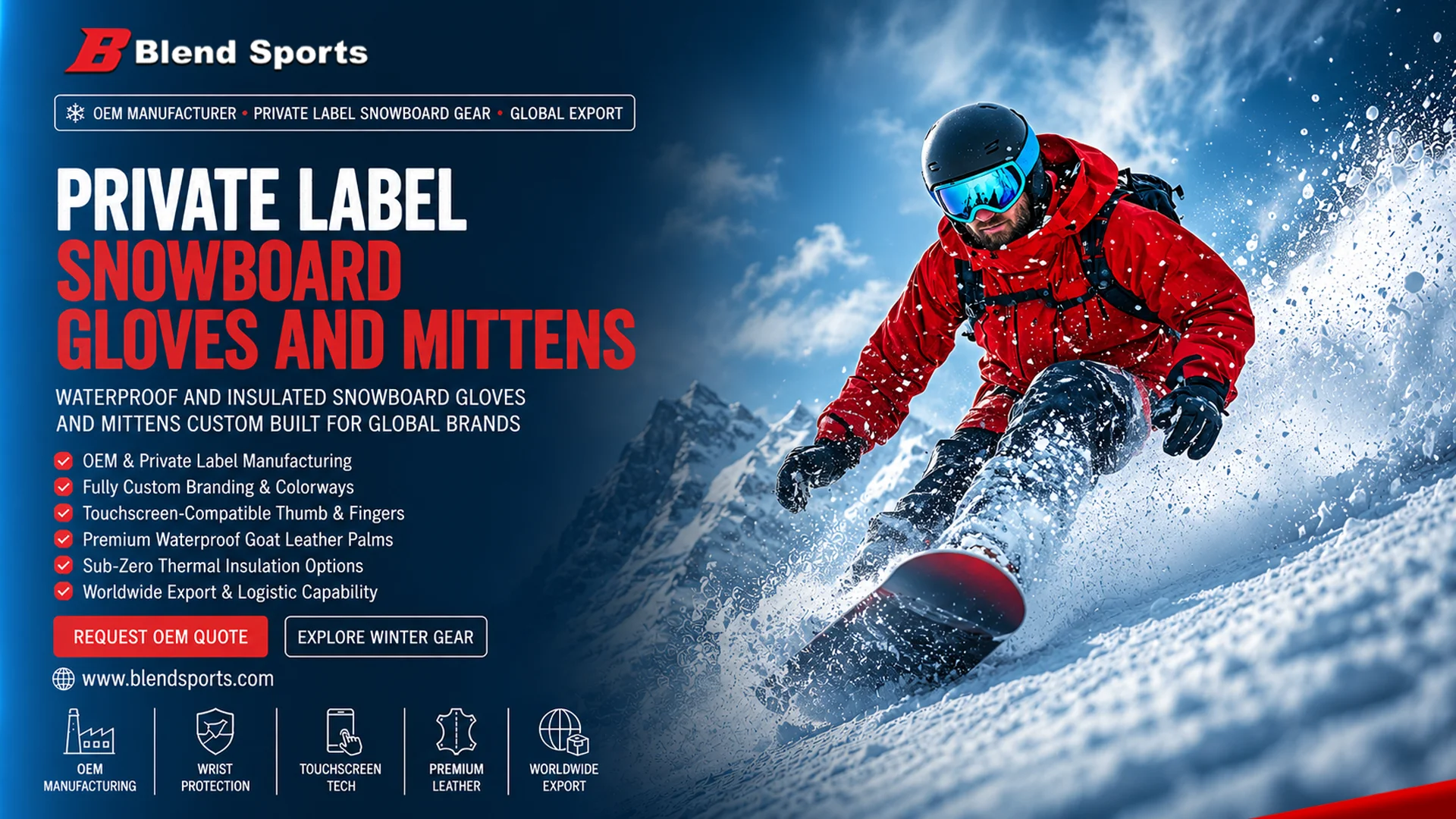
The Physics of Snowboard Glove Performance
Snowboard gloves exhibit distinct wear patterns, particularly on the palms, from repeated binding adjustments, board-edge abrasion, and wrist impacts during falls on packed snow. These stresses demand specialized materials and a different build approach beyond standard wind or thermal protection.
Thermal requirements for snowboard gloves are equally distinct. Snowboarders generate heat during descents but rapidly cool when stationary, unlike snowmobile riders, who face constant wind chill. Gloves must release moisture during activity and retain warmth during rest, without engine-generated heat.
Blend Sports produces private-label snowboard gloves and mittens built for these specific demands — chrome-tanned leather with silicone-polymer grip, integrated wrist protection, activity-specific insulation, and reinforced palms for reliable performance across park, all-mountain, and backcountry disciplines. Consistent production supports inventory planning and enables timely seasonal deliveries. Scalable manufacturing meets winter programme requirements while maintaining approved specifications.
Binding Mechanics and Palm Wear Patterns
Standard winter gloves do not withstand these unique stress patterns. Understanding the physics of binding contact highlights the importance of specialized manufacturing.
| Contact Point | Force Type | Repetition Rate | Material Response Required | Failure Mode Without Optimization |
|---|---|---|---|---|
| Binding Strap Interface | Torsional shear + tensile load | 50-150 adjustments per session | Chrome-tanned leather with silicone grip finish maintaining traction on wet nylon | Slip failure, accelerated palm wear, grip loss in wet conditions |
| Board Edge / Grab Contact | Abrasive contact + impact | Variable (grabs per run) | Reinforced outer palm edges and finger bases with high-density stitching | Abrasion-through, structural compromise at high-wear zones |
| Wrist Impact Zone | Compressive + torsional impact | Fall-dependent (high variability) | Integrated TPU protection or dual-density support systems | Fracture risk, long-term joint damage, warranty claims |
| Thermal Cycling | Sweat saturation + evaporative cooling | Active-to-idle transitions every 10-15 minutes | High vapor-transmission membranes (25K+) with moisture-wicking lining | Internal moisture buildup, cold-hand complaints, delamination |
Snowboarding creates mechanical stresses that do not occur in skiing or other winter sports. Addressing these physics-driven requirements early in development prevents the failure modes common in generic glove manufacturing.
Thermal and Mechanical Benchmarks by Discipline
Alpine / Freeride Configuration
- Insulation weight: 200g–280g synthetic or treated down
- Waterproof rating: 20,000mm+ hydrostatic head
- Palm reinforcement: Kevlar® or Cordura® with vibration-dampening inserts
- Cuff architecture: Gauntlet-style with dual-draw closure to seal over jacket sleeves
- Operating temperature range: -15°F to 35°F active, -25°F static
Park / Street Configuration
- Reduced insulation: 60g–100g for high-output trick repetition
- Enhanced dexterity rating: 8/10 on standardized grip tests
- Impact protection: Hard-shell knuckle guards, wrist splint integration
- Palm material: Reinforced synthetic leather with silicone grip pattern
- Operating temperature range: 5°F to 45°F (shorter exposure windows, higher exertion)
Backcountry / Splitboard Configuration
- Hybrid insulation mapping: Variable loft zones (high-loft backhand, reduced palm)
- Cuff system: Under-jacket slim cuff with wrist leash and carabiner loop
- Touchscreen compatibility: Full-finger conductive treatment (navigation device operation)
- Packability: Compressible to 30% of expanded volume for uphill stowage
- Operating temperature range: -10°F to 25°F with high humidity management priority
The private label program offers branded production and technical support, allowing brands to expand their snowboard glove lines through Blend Sports' manufacturing expertise and material sourcing capabilities.
Component Stack and Upgrade Economics
Membrane Technology Tiers
| Component Level | Technology | Performance Characteristic |
|---|---|---|
| Entry | PU-coated fabric | 10,000mm waterproof, moderate breathability |
| Mid | Microporous PU laminate | 15,000mm/10,000g/m²/24hr breathability |
| Advanced | ePTFE membrane (licensed) | 25,000mm+/15,000g+ breathability, durable |
| Proprietary | Bespoke hydrophilic matrix | Custom moisture-vapor transmission rates |
Insulation Material Matrix
| Material | Warmth-to-Weight | Compressibility | Moisture Performance |
|---|---|---|---|
| Polyester fiberfill | Moderate | Good | Poor when wet, slow dry |
| Synthetic cluster (PrimaLoft® Gold equivalent) | High | Excellent | Retains 95% warmth when wet, fast dry |
| Treated down (hydrophobic) | Very High | Superior | Improved wet performance, premium dry warmth |
| Hybrid mapping (zoned synthetic/down) | Optimized per zone | Zone-dependent | Targeted moisture handling by hand region |
Component-Level Upgrade Economics
| Component | Standard Specification | Performance Upgrade | Cost Impact | Performance Benefit |
|---|---|---|---|---|
| Palm Leather | Chrome-tanned goatskin | Silicone polymer grip finish | +$0.80–1.20/pair | Improved wet nylon strap grip; extended service life at binding contact zones |
| Insulation | 3M™ Thinsulate™ (standard) | PrimaLoft® Gold or removable liner systems | +$2.00–3.50/pair | Improved wet-weather warmth retention; thermal flexibility for backcountry use |
| Membrane | 20K TPU waterproof | Hipora® 25K+ high vapor transmission | +$1.50/pair | Recommended for high-output park and backcountry use |
| Wrist Protection | Standard TPU insert (0.5mm) | Dual-density TPU system (0.8mm) | +$1.80/pair | Improved impact distribution during falls without restricting flex |
| Cuff Design | Standard under-jacket cuff | Extended gauntlet with snow skirt | +$1.00–1.50/pair | Powder protection for backcountry disciplines |
Silicone grip finishing increases durability at binding contact zones with minimal added cost. Dual-density TPU systems enhance impact distribution and are often specified for park-oriented product lines.
Stitching, Padding, and Binding Fit
Seaming and Stress Points
Flatlock and overlapped seaming creates failure points under snowboard-specific stresses, particularly the lateral pull exerted during toe-side carves and the compression loading from heel-edge impacts. Proper specification includes:
- 3D curved finger patterning: Reduces seam tension across the knuckle line compared with standard straight-finger patterning, improving durability under flex cycling
- Reinforced stress points: High-density stitching at thumb base and pinky edge (high-tear zones during falls)
- Bonded seam taping: 20mm waterproof tape coverage on all interior seams, heat-activated for durability
Impact Protection Integration
Unlike snowmobile gloves where protection centers on wind and debris deflection, snowboard gloves must manage kinetic energy from falls and edge contact:
- Knuckle armor: ABS or TPU shells integrated into the backhand insulation layer, positioned to avoid binding interference
- Wrist stabilization: Optional removable splint system (aluminum or carbon fiber stays) to prevent hyperextension during hand-plant falls
- Palm padding: Viscoelastic foam positioned at the heel of the palm to absorb edge impacts and reduce ulnar nerve compression during extended carves
Binding Interface Compatibility
Glove cuff bulk and wrist articulation must align with snowboard binding straps and ratchet systems to ensure proper fit and function — a specification often overlooked.
- Cuff profile: Tapered angle to match natural wrist position in riding stance
- Strap clearance: Backhand padding reduced at strap contact zones to prevent stack height interference
- Lever operation: Thumb and index finger enhanced for ratchet manipulation (reduced insulation, reinforced make)
Cuff Design and Snow Entry Prevention
Snowboard riders require different cuff configurations than skiers based on riding style and snow exposure.
Under-Jacket Cuff (Park / All-Mountain):
- Low-profile design fitting under jacket sleeves for unrestricted arm movement during grabs and balance adjustments
- Elasticized wrist seal as primary barrier with single-hand drawcord for quick donning/doffing
- Pre-curved finger box design aligned with natural board-hold position
Extended Gauntlet (Backcountry / Powder):
- Extended 5-6 inch gauntlet with ripstop nylon shell overlapping jacket sleeves
- Integrated snow skirt with shock-cord barrel lock adjustment preventing snow entry during falls
- Recommended for deep powder and backcountry where snow contact is prolonged
Rider-First Glove Details
Moisture Handling
Snowboarding generates significant perspiration even in cold conditions. Proper glove architecture addresses this through:
- Vapor-permeable liners: Hydrophilic monolayer that transports moisture from skin to membrane without liquid-phase accumulation
- Quick-dry zones: Mesh ventilation panels at high-sweat areas (palm center, between fingers) that remain closed during precipitation
- Removable liner systems: Two-layer build allowing independent drying; secondary liner can be swapped mid-day (reserved for backcountry applications where thermal flexibility justifies the compromise)
Dexterity Under Load
Maintaining finger independence while insulated is critical for binding operation and edge control feedback:
- Articulated pre-curve: Patterning matches hand position at 15° flexion (neutral riding grip)
- Reduced seam count: Fewer seams in the finger box compared with standard winter gloves, improving flexibility and reducing failure points
- 4-way stretch panels: Lycra® or mechanical stretch woven fabric at knuckles and webbing to preserve range of motion
Safety and Visibility Features
- Reflective piping: 3M Scotchlite™ or equivalent on cuff and backhand for low-light visibility
- Wrist leash system: Kevlar®-cored elastic with quick-release buckle (prevents loss during falls, allows emergency detachment)
- Nose wipe panel: Soft microfiber zone at thumb back (frequent use in cold conditions, positioned to avoid ice accumulation)
Thermal Management by Activity Physiology
Different riding styles create distinct metabolic heat profiles and thermal regulation requirements.
Park / Freestyle: High-output anaerobic activity generates substantial metabolic heat. Primary risk is overheating and sweat saturation. Lighter insulation (60g–100g) with maximum vapor transmission (25K+) is essential.
All-Mountain: Variable aerobic and anaerobic exertion across changing terrain. Balanced insulation (100g–150g) with moderate breathability (20K) provides versatile thermal regulation.
Backcountry / Splitboarding: High-exertion climbing generates heat; descents and transitions require warmth. Removable liner systems allow thermal adjustment that fixed insulation cannot provide.
Specifications by Riding Discipline
| Discipline | Insulation Weight | Membrane Rating | Key Build Features | Performance Priority |
|---|---|---|---|---|
| Park / Freestyle | 60g–100g 3M™ Thinsulate™ | 25K+ vapor transmission | Silicone grip palm; reinforced outer edges; pre-curved box fingers | Heat dissipation and sweat management |
| All-Mountain | 100g–150g 3M™ Thinsulate™ | 20K waterproof/breathable | Reinforced palm center; wrist protection compatible | Versatile durability across variable conditions |
| Backcountry / Splitboard | Removable PrimaLoft® liner system | Hipora® 25K+ high vapor transmission | Articulated fingers; low-profile cuff design | Activity-level thermal adaptation |
| Performance / Racing | 80g–120g 3M™ Thinsulate™ | Maximum dexterity membrane | Streamlined under-jacket cuff; minimal insulation | Tactile board control feedback |
Activity intensity and metabolic output influence insulation requirements as much as ambient temperature. Segment-specific benchmarks ensure gloves match physiological demands before production approval.
Snowboard Glove Cost Structure
Volume Pricing Mechanism
| Annual Volume | Cost Reduction | Cost Driver |
|---|---|---|
| 1,000+ pairs | 5–8% | Dedicated line allocation, reduced setup overhead |
| 2,000+ pairs | 10–14% | Material pre-positioning, custom dye lot efficiency |
| 3,500+ pairs | 15–18% | Membrane volume licensing, component molding investment |
Consistent production supports inventory planning and enables timely seasonal deliveries. Scalable manufacturing meets winter program requirements while maintaining approved specifications.
Video summary: A short overview of custom ski/snowboard glove and mitten options, including insulation, palm reinforcement, wrist protection, branding, and OEM production.
Production Capabilities and Quality Assurance
Since 2015, material selection has been qualified specifically for snowboarding conditions, including wet nylon abrasion resistance, repeated flex cycling, and impact absorption. Sampling validates performance under snowboard-specific stress patterns before production approval.
Production follows approved technical documentation, including the tech pack, specified materials, measurements, and tolerances. No material substitution or design change is made without prior authorization.
Quality Control Protocol
Material Verification: Incoming chrome-tanned leather inspection for consistency, flexibility, and grip performance characteristics
In-Process Inspection: Stitch density verification at high-stress zones; TPU insert placement accuracy
Pre-Shipment Review: Waterproof/breathable membrane integrity testing; flex cycle durability validation
Final AQL 2.5 Audit: Random sampling ensures batch consistency meets specification tolerance
ISO 9001:2015 Certified: Blend Sports adheres to ISO 9001:2015 for consistent quality from sampling through production
Snowboard Glove Development: From Spec to Shipment
- Weeks 1-2: Product Definition
Review riding discipline (park vs. all-mountain vs. backcountry), biomechanical requirements, and material feasibility assessment. - Weeks 3-6: Prototype Development
Two prototype rounds with field validation testing binding grip durability, wrist protection fit, and membrane breathability under actual winter conditions. - After Sample Approval: Production & Quality Control
Bulk production typically takes 60–90 days and includes multi-stage inspection from incoming materials through final AQL 2.5 sampling.
Typical Timeline: Sampling takes 4–6 weeks after specifications and materials are confirmed. Bulk production takes 60–90 days after sample approval and order confirmation.
Snowboard Glove Technical Inquiry
Submit your product requirements for review. Our production team will assess feasibility, recommend specifications, and outline sampling and production protocols.
What to Provide
- Tech pack with specifications
- Material sourcing model (brand-supplied or market-sourced)
- Target production volume
- Required delivery timeline
Process Overview
- Review tech pack specifications
- Prototype development
- Sales samples, if required
- Bulk production after purchase-order approval
Frequently Asked Questions: Snowboard Glove Manufacturing
What are your minimum order quantities for custom snowboard gloves?
Minimum order quantities depend on design complexity. We support both emerging brands launching their first private-label products and established brands scaling proven designs.
How do you address palm wear from snowboard binding adjustments?
Chrome-tanned leather palms with silicone polymer grip finishing are designed for wet nylon binding strap contact. Strategic reinforcement at outer palm edges and finger bases extends service life compared with standard leather finishing.
What insulation setup is best for park versus backcountry riding?
Park riders benefit from lighter insulation (60g–100g) with high breathability to manage heat during active sessions. All-mountain riders typically require balanced insulation (100g–150g). Backcountry riders benefit from removable liner systems for thermal flexibility during climbs and descents.
How long does snowboard glove development take from sample to delivery?
Sampling typically takes 4 to 6 weeks after specifications and materials are confirmed. Bulk production typically takes 60 to 90 days after sample approval and order confirmation.
Do you support OEM and private label snowboard glove projects?
Yes. OEM and private label programs are supported with pattern development, material selection (including chrome-tanned and drum-dyed leather, silicone grip finishes, 3M™ Thinsulate™, and Hipora® membranes), branded execution, sampling, and production planning.
Do you manufacture heated snowboard gloves?
No. Blend Sports manufactures non-heated snowboard gloves and mittens. If a brand uses third-party heating components, the glove pattern can be reviewed for compatibility, but Blend Sports does not supply or manufacture the heating components.
Do you provide samples before production?
Yes. Pre-production samples are provided to ensure that fit, materials, trims, and hardware meet tech-pack specifications before the full production run begins.
What markets do you serve as a snowboard glove manufacturer?
Blend Sports works with brands across North America and Europe, supporting both emerging and established winter sports brands.
How do you ensure consistent quality in custom snowboard glove manufacturing?
Production follows approved technical documentation with no material substitutions or design changes without prior authorization. Quality checks cover incoming materials, in-process workmanship, pre-shipment review, and a final AQL 2.5 audit within Blend Sports' ISO 9001:2015 quality management framework.
Technical Note: Named material brands — including 3M™ Thinsulate™, Hipora®, Kevlar®, PrimaLoft®, YKK®, and 3M™ Scotchlite™ — are subject to supplier availability and project approval. Suitable unbranded alternatives can also be evaluated against the brand partner's performance requirements and target price. Materials are confirmed during sampling before bulk production.